


Grok, xAI’s model, is positioned quite differently from the flagship models of other major tech companies: it issues fewer rejections, has a more “blunt” tone, and carries an implicit promise of “less moderation.” The interesting question isn’t “which side is right,” but rather a more technical one: what does looser censorship actually bring to the table, and how does it relate to the model’s capabilities? Answering this question objectively requires, first and foremost, untangling a jumble of concepts that have been lumped together.
"Censorship" is not a single axis, but four
Most of the debate reaches an impasse because people use the same word for four very different things. Once you distinguish between them, the picture becomes clear:
| What’s being lumped together | What it actually is | Type of issue |
|---|---|---|
| Rejection rate | Does the model provide a clear answer or make excuses to avoid it | Experience / Product |
| Political bias filtering | Biased toward one side in controversial questions | Values, not competence |
| Safety barriers | Blocks weapons, malware, and content harmful to children | Nearly every company maintains |
| "Safety tax" | The hypothesis that security tweaks reduce raw performance | Unresolved technical questions |
When someone praises or criticizes "Grok for having little moderation," they’re usually mixing all four. Grok may have fewer restrictions (axis 1), a different political lean (axis 2), while still maintaining its core safety barriers (axis 3)—three independent factors. Without separating them, it’s impossible to have a meaningful discussion.
Where does ability come from—and where doesn't it come from?
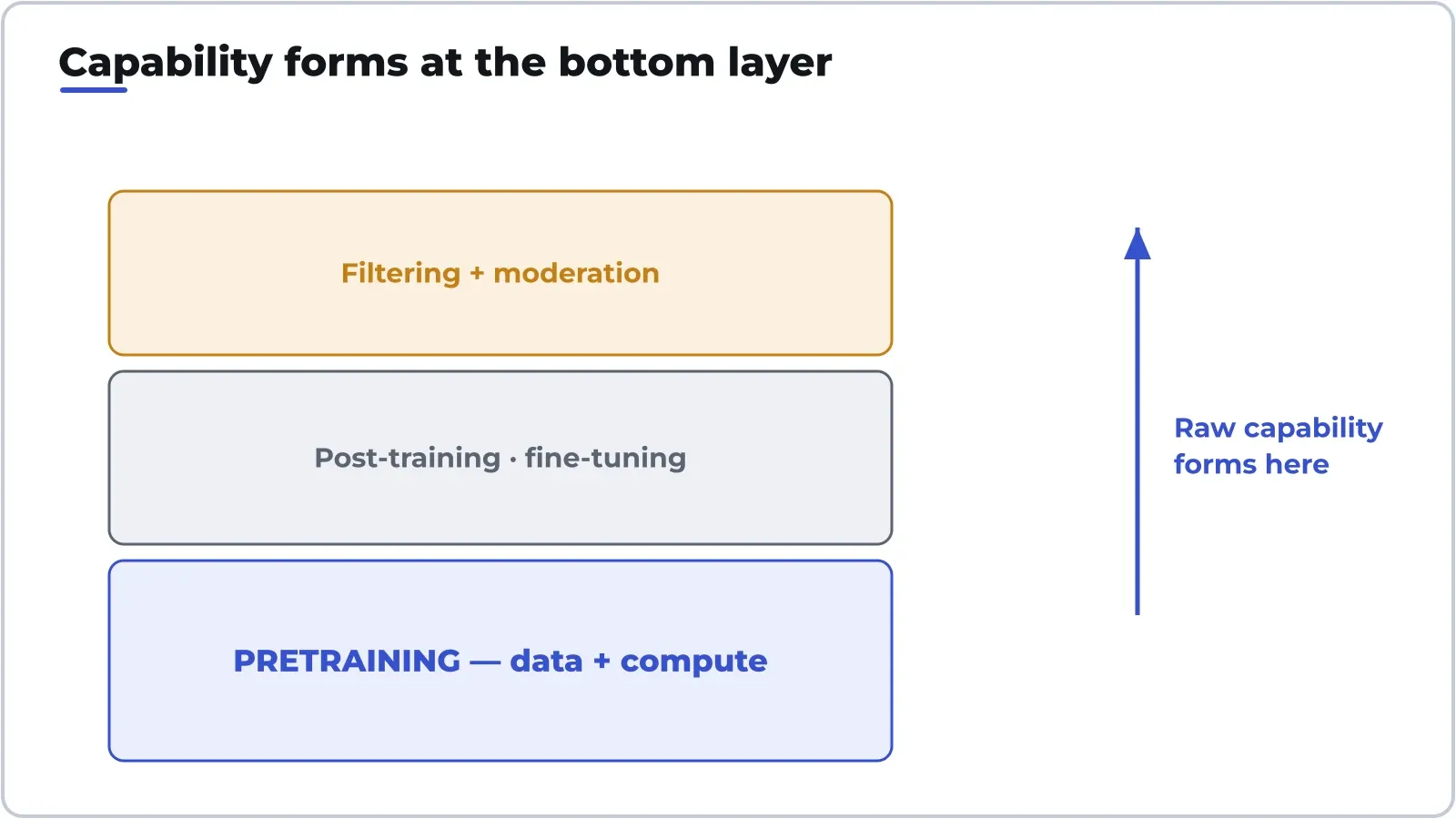
This is the key point that both Grok’s supporters and critics tend to overlook: a model’s raw capabilities are almost entirely determined during the pre-training phase—how much data, how much computation, and what the architecture looks like. That’s where the model “learns” nearly everything it knows. How well a model can solve math problems or write code is determined during that phase, before any validation takes place.
This leads to an important conclusion: “less censorship” is hardly a source of capability. If Grok excels at a particular task, that stems from xAI’s computations and data, not from the fact that it’s willing to say things other models avoid. Removing censorship does not make a model smarter; it merely makes the model say more things—two entirely different matters that marketing slogans deliberately conflate.
Content moderation is different from controlling viewpoints
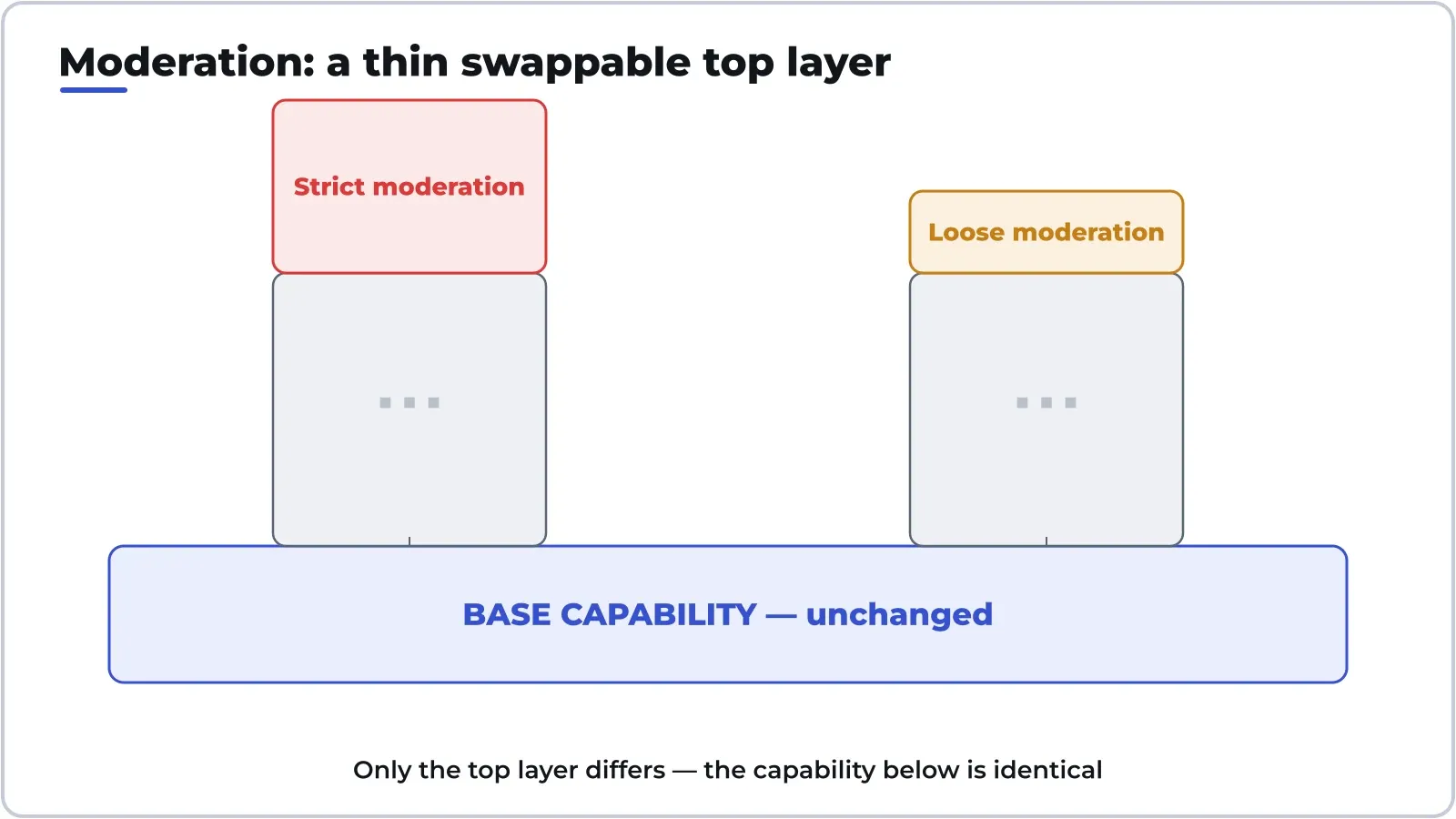
The most common fallacy in this discussion is conflating content moderation (a model that takes no stance) with censorship in the sense of controlling viewpoints (a model that leans toward one political side). These two are fundamentally different: blocking instructions on how to make weapons is a form of moderation that nearly everyone agrees on; whereas skewing answers toward a particular value system is a value-based choice that each side will view as “neutral” in its own way. The challenge is that no model is truly “value-neutral”—every choice regarding how to respond carries a value system, including the choice to appear unbiased. Grok’s “less moderation,” in this context, isn’t about removing values but rather replacing one value system with another—and presenting it as neutral.
Technically speaking, both alignment and filtering are thin layers applied after the model has been trained: supervised fine-tuning, learning from feedback, and output filters. This layer is replaceable and adjustable without the need for retraining from scratch—that’s why a company can release multiple different “personalities” on the same base model.
Is the "adjustment tax" real?
This is the only area where censorship can affect performance, and it’s important to present both sides of the argument for the sake of fairness. There is evidence that excessive safety tuning slightly reduces performance on certain tasks—the so-called “tuning tax.” But two points need to be made clear: first, that penalty is usually small and still a matter of debate; second, the far more obvious harm comes not from a loss of capability but from excessive rejection—the model making excuses to avoid entirely valid requests, making it difficult to use. This is a genuine user experience issue, and it’s where Grok’s “low rejection” approach holds practical value. But it’s a matter of usability, not intelligence—a model that’s willing to provide more responses doesn’t solve harder problems; it simply tries.
So what does Grok actually sell?
Taken together, what Grok offers isn’t a technological leap but rather a value proposition combined with brand positioning: a model that’s more outspoken, aligned with a value system outside the mainstream, and marketed as “more freedom.” This may be what some users truly want—and it’s a legitimate product choice. But calling it a competitive advantage is misleading: the true competitive advantage lies in computing power and data, while “less censorship” is just a thin layer on top. Two different types of buyers are evaluating two different things, and mixing them together only leads to pointless arguments.
Predicting the Next Steps
If the framework that "censorship is a thin layer, separate from capability" is correct, it offers some fairly specific predictions about the future direction:
- Moderation will be personalized rather than fixed. Because the filtering layers are separate and interchangeable, the natural approach is for users—or businesses—to choose the appropriate level of filtering, rather than a single standard applied to everyone. "Bold Grok" and "Cautious Business Assistant" will eventually be two configurations on the same underlying model, not two separate products.
- The market will fragment based on values, not capabilities. As the capabilities of leading models converge, the point of differentiation shifts to the value system each model embodies—and users will choose the model that aligns with their worldview, just as they choose a newspaper. This is a form of social fragmentation that is more concerning than a technical advancement.
- The open model will push “less censorship” to the extreme. No matter what the big companies do, the open-source model allows anyone to completely remove the filtering layer. The debate over “Company X’s censorship” will eventually become secondary, because the option of “no filtering at all” will always exist out there — and that shifts the focus from “what should companies filter” to “how will society handle it when filtering is optional.”
- Regulations will target safety measures, not political views. Potential legislation will focus on areas where there is broad consensus—blocking weapons, combating fraud, protecting children—rather than imposing a political viewpoint standard, since no democratic government can define “neutrality” without being perceived as biased. The line between safety (which can be regulated) and opinion (which should not be regulated) will be the legal battleground of the coming years.
The underlying theme: The Grok story is interesting not because it answers the question of whether “censorship is good or bad,” but because it forces us to distinguish between capability and values—two things that the industry, users, and marketers alike benefit from conflating. Separating them is a prerequisite for discussing AI in a level-headed manner, rather than taking sides.
Note: This article analyzes general mechanisms and dynamics; it is not intended to validate any specific statements made by a model—specific examples should always be verified at the time of reading, as model behavior changes with each update.
Thảo luận