

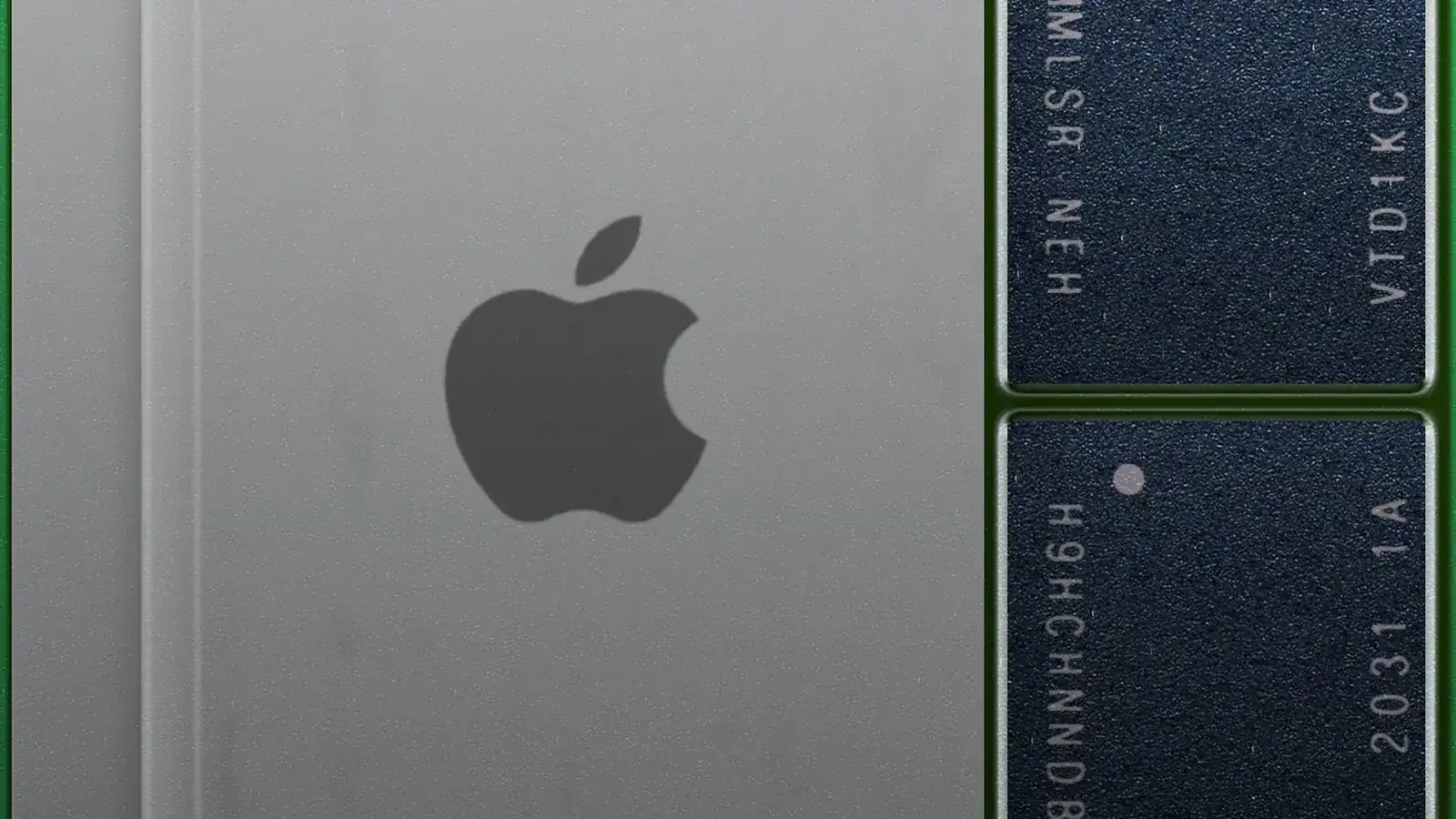
In 2020, Apple took a step that the entire industry considered risky: it abandoned Intel chips—the foundation of Mac computers for fifteen years—to build its own chips for its computers. Previous shifts in processor architecture throughout the industry’s history have been fraught with risk and have often ended in failure. Yet this time, the transition went almost seamlessly, and after just one generation, Apple Silicon has redefined what we expect from a laptop: cool, quiet, all-day battery life, and still fast. The question worth asking isn’t “how powerful are Apple’s chips?” but rather “how did they pull it off?”—because the answer holds lessons for anyone building complex products.
It's not a miraculous invention, but rather vertical integration
The most common misconception is that Apple discovered some technical secret that Intel or AMD didn’t know. The truth is different: most of the ideas behind Apple Silicon were already known. What Apple has that pure-play chipmakers don’t is control over the entire technology stack—chips, operating systems, compilers, and even relationships with foundries. When you control all four of those elements, you can optimize the points where they intersect—something a company that focuses on just one aspect can never achieve, because each party optimizes for its own part, and no one takes responsibility for the whole.
Unified memory: eliminates the need for copying
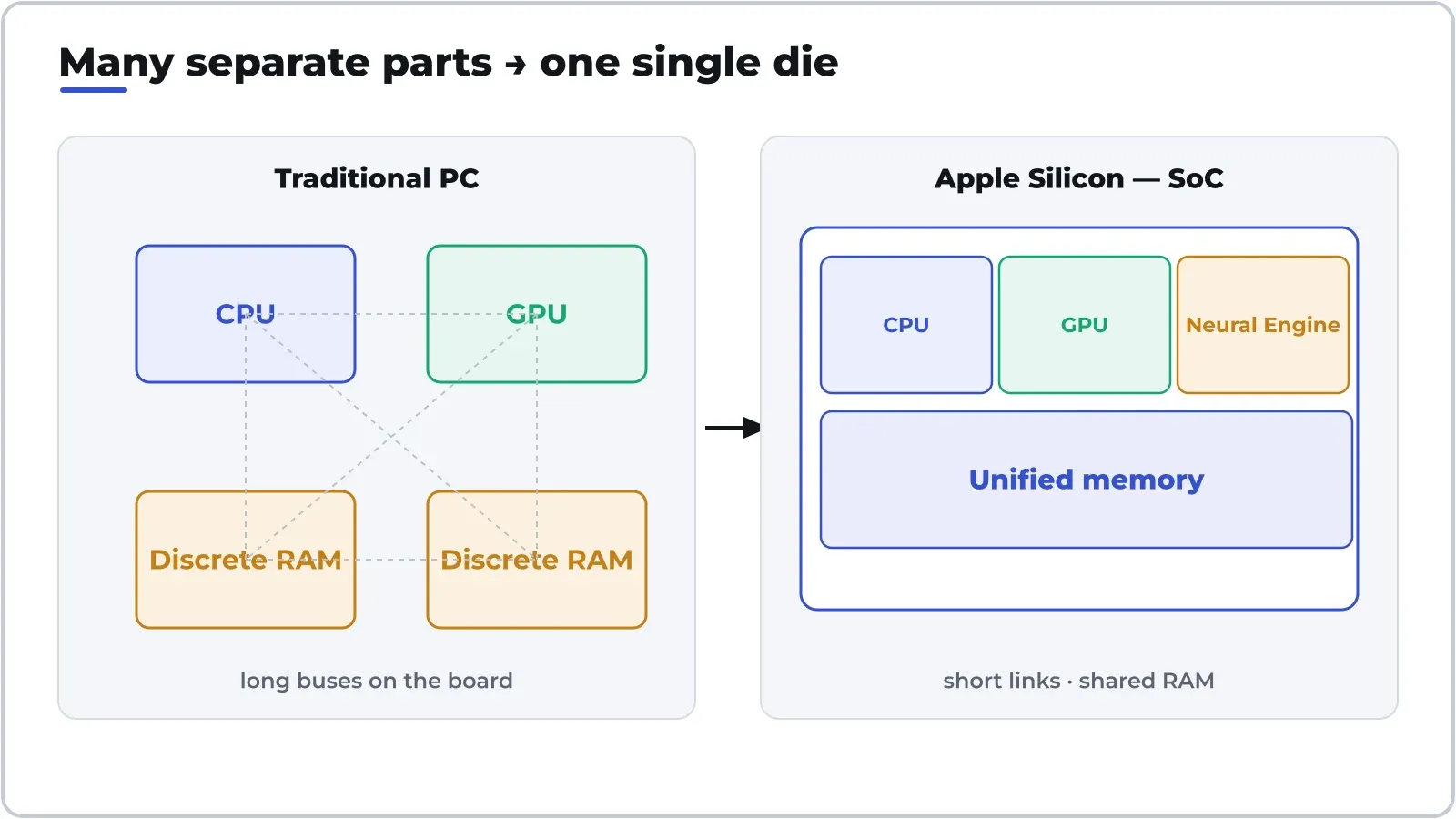
In a traditional computer, the CPU has its own RAM, while a discrete GPU has its own RAM. For the GPU to process data prepared by the CPU, the data must be copied from one memory space to another via a data path—a process that takes time and consumes power, and for tasks involving a mix of different types of computations, that copying step can sometimes account for a significant portion of the effort.
Apple Silicon consolidates everything into a single shared memory space that the CPU, GPU, and neural processor all access directly. No more copying, no more waiting. This is a decision that’s only feasible when you design both the chip and the software that uses it—a company that sells discrete chips to many different customers cannot impose such a memory architecture. Along with the article on virtual memory, this is another layer of optimization for the same scarce resource.
The brake shaft really delivers performance per watt
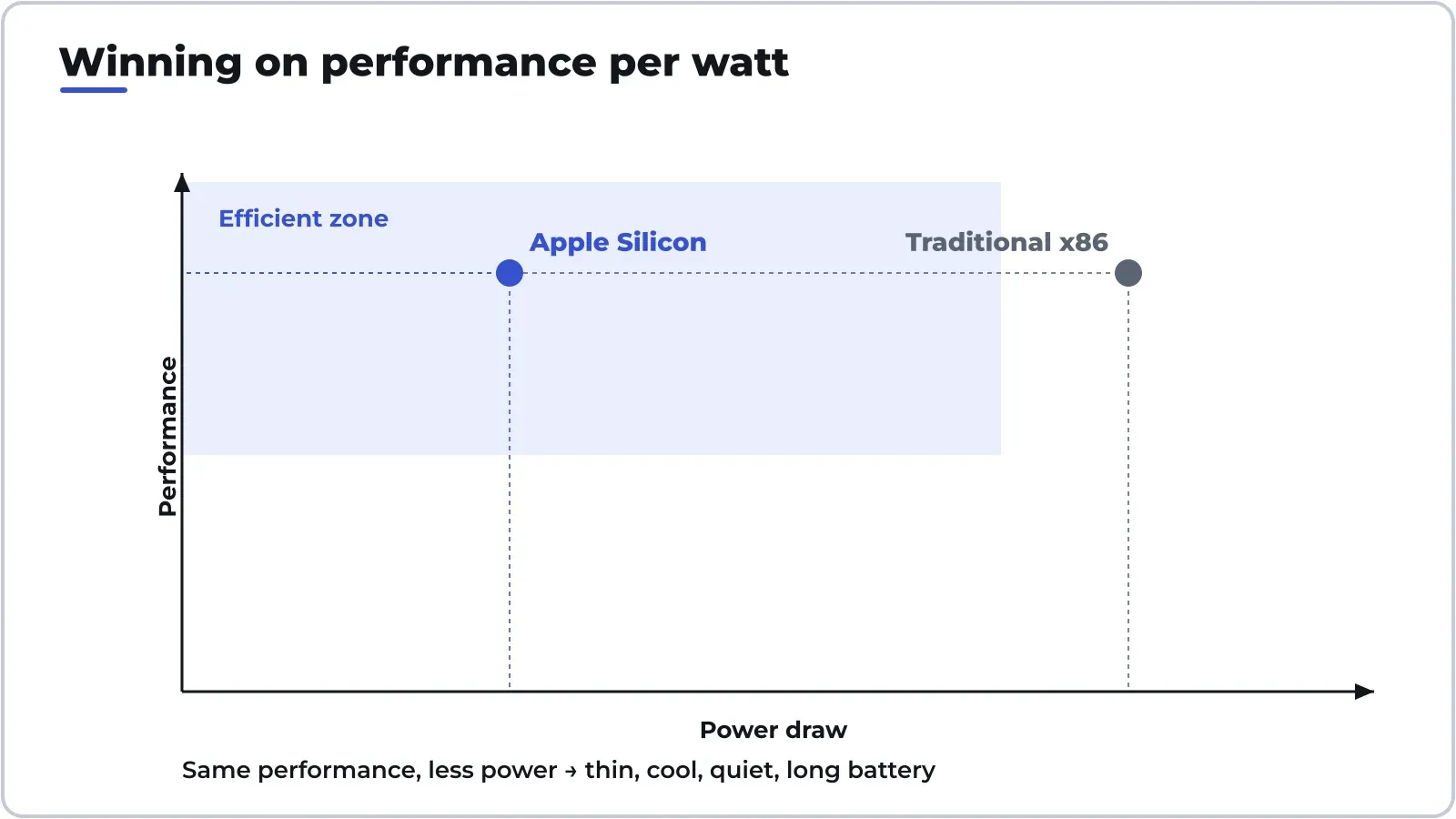
For years, the chip race has been defined by peak performance—the highest numbers achieved under maximum load. Apple wins on a different front, and choosing that front is the smart move: performance per watt. With a laptop or phone, what determines the user experience isn’t peak performance but how much work can be done per unit of power—because power determines heat, heat determines fan speed, and all three determine battery life. A chip that achieves the same level of performance at a much lower power consumption results in a device that stays cool, runs quietly, and lasts all day without needing to be plugged in. That’s what users experience every day—unlike peak numbers that only appear in benchmark charts.
The Software Mastery Behind Hardware Success
Changing the processor architecture means that all legacy software, compiled for Intel chips, suddenly runs on a chip that doesn’t understand its machine language. This is exactly where previous transitions often failed: users would upgrade, find that their familiar apps wouldn’t run, and turn away. Apple solved this with a translation layer called Rosetta 2—it translates Intel code into Apple code, with most of the translation happening during installation and the rest done on the fly while running, so smoothly that most users didn’t even realize their apps were being translated. The hardware success that the whole world marvels at actually rests on a software feat that almost no one sees—and that’s also a lesson: the success or failure of a major transition hinges on whether it causes pain for existing users.
Success Thanks to the Supply Chain
We need to be honest about one advantage that doesn’t stem from Apple’s design expertise: the company has access to TSMC’s leading-edge manufacturing process, as it is typically the first customer for each new process generation. A chip manufactured on a more advanced process offers power and density advantages that even the most ingenious design on an older process would struggle to match. A significant portion of the performance-per-watt advantage stems from this—from the supply chain and the financial resources to pre-book production capacity—not from a smarter circuit design. To overlook this factor is to misunderstand the lesson.
Lessons for Other Companies — and Its Limitations
The key lesson is that vertical integration wins when the points of intersection are the most critical areas of optimization. When value lies at the intersection of chips and the operating system, or of hardware and software, the company that controls both ends will come out on top. But—and this is the part that those captivated by the Apple story often overlook—vertical integration also comes at a cost. It locks you into a single ecosystem, severely limits your ability to mix and match components from different vendors, and requires massive scale to bear the costs of building every layer in-house. It’s only worthwhile if you’re large enough to afford in-house chip design and focused enough to avoid catering to hundreds of different configurations. For most companies, following Apple’s path isn’t wise—it’s suicide—as discussed in the article on vendor lock-in: control always has two sides.
Predicting the Next Steps
If the argument that "vertical integration wins at the intersection" is correct, it allows us to predict some fairly specific directions of development:
- Major companies will develop their own chips tailored to their specific workloads. This trend has already begun and will accelerate: cloud providers and large software companies are designing custom chips for servers and AI—not to sell, but to optimize their specific workloads. The benefit lies not in the fact that these chips are faster than those from specialized manufacturers, but in the fact that they are perfectly tailored to the software running on them.
- Unified memory and “mixed-computing” architectures will spread to AI servers. The challenge of data copying between the CPU and accelerators is currently the bottleneck for training and inference of large models—and the solution will follow the path Apple has taken with desktop computers.
- The industry-wide race is shifting from peak performance to performance per watt. As power consumption becomes a real constraint for both data centers and mobile devices, the path Apple has chosen will become the main arena where every company must compete—including those that have long boasted only about peak performance figures.
- Open instruction-set architectures will gradually erode the areas where vertical integration falls short. Not everyone is large enough to build the entire stack in-house like Apple; for the rest, an open, royalty-free instruction set architecture that allows multiple parties to customize it will be the pragmatic path—vertical integration for the giants, open standards for everyone else.
The common thread among these four predictions: what Apple has demonstrated is not “be like Apple,” but rather where value is shifting—from individual components to the way they are assembled. Whoever controls the assembly process—whether through vertical integration or open standards—will shape the next phase.
Thảo luận