

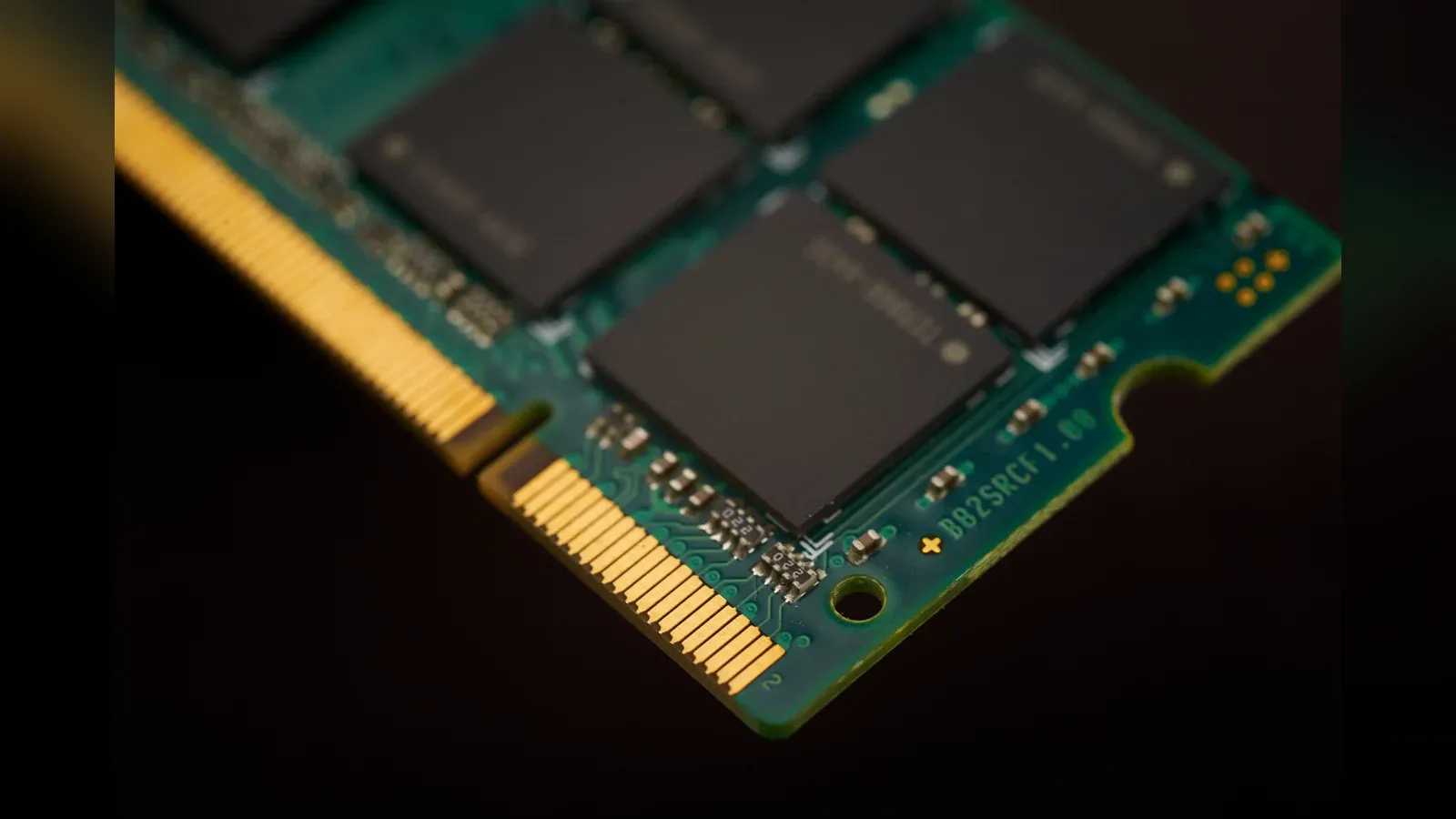
In the second half of 2025 and early 2026, computer memory prices skyrocketed. Contract prices for DDR5 jumped by tens of percent each quarter, while manufacturers phased out DDR4, causing spot market prices to at times double or triple; HBM for GPUs was sold out through 2026. The strange thing is: this isn’t a sudden shock caused by a shortage of factories. It’s a reallocation—AI is absorbing the lion’s share of production capacity, and everything else has to fight over the scraps.
What's going on?
Memory has always been a product subject to sharp cyclical fluctuations. But this cycle is fundamentally different: the surge in demand isn’t driven by the PC or smartphone cycles, but by AI data centers. The three major manufacturers—Samsung, SK hynix, and Micron—are shifting their production lines to HBM (high-bandwidth memory attached to GPUs) because the profit margins are many times higher. The ripple effect:
- Shortage of mainstream DRAM: DDR5 prices for servers and PCs have risen sharply; DDR4 production has been discontinued early, causing spot prices to surge.
- HBM remains in short supply: nearly the entire production volume of HBM3E/HBM4 has been pre-ordered several quarters in advance.
- Impact Across All Sectors: Smartphones, laptops, cars, and IoT devices are all facing higher prices or supply delays as they compete for the same wafer supply.
Why Demand Seems Bottomless: AI's Economic Breakthrough
To understand why hyperscalers are willing to pay any price for HBM, you have to look at how that memory generates revenue. From 2024 through 2025–2026, AI will cross the threshold from being a “question-answering assistant” to delivering real economic value:
- Programming assistants and agents write, edit, and test code—saving hours of engineer labor, the most expensive resource in the software industry.
- Inference models (the “think-before-you-answer” type) can solve more complex problems, but they consume many times more computational resources during inference—each response requires more memory to maintain long chains of thought and context.
- Process automation: customer service, document analysis, advertising & recommendations — every percentage point of improvement translates to billions in revenue at scale.
When each “unit of intelligence” can be converted into economic value, the hardware costs required to run it become an investment rather than an expense. This is why the four major cloud providers are increasing their capital expenditures (capex) by hundreds of billions of dollars each year—and for them, falling behind in AI is far more dangerous than paying a premium for memory.
The paradox only fuels the frenzy: every time a cheaper and more efficient model emerges (like the “DeepSeek moment”), the cost per use decreases—but total demand actually increases because people use it more when it’s cheaper (the Jevons paradox). Lower prices don’t quench the thirst for chips; they multiply the number of people and projects pouring into AI.
Why Can't Supply Keep Up?
The supply side is subject to four overlapping forces:
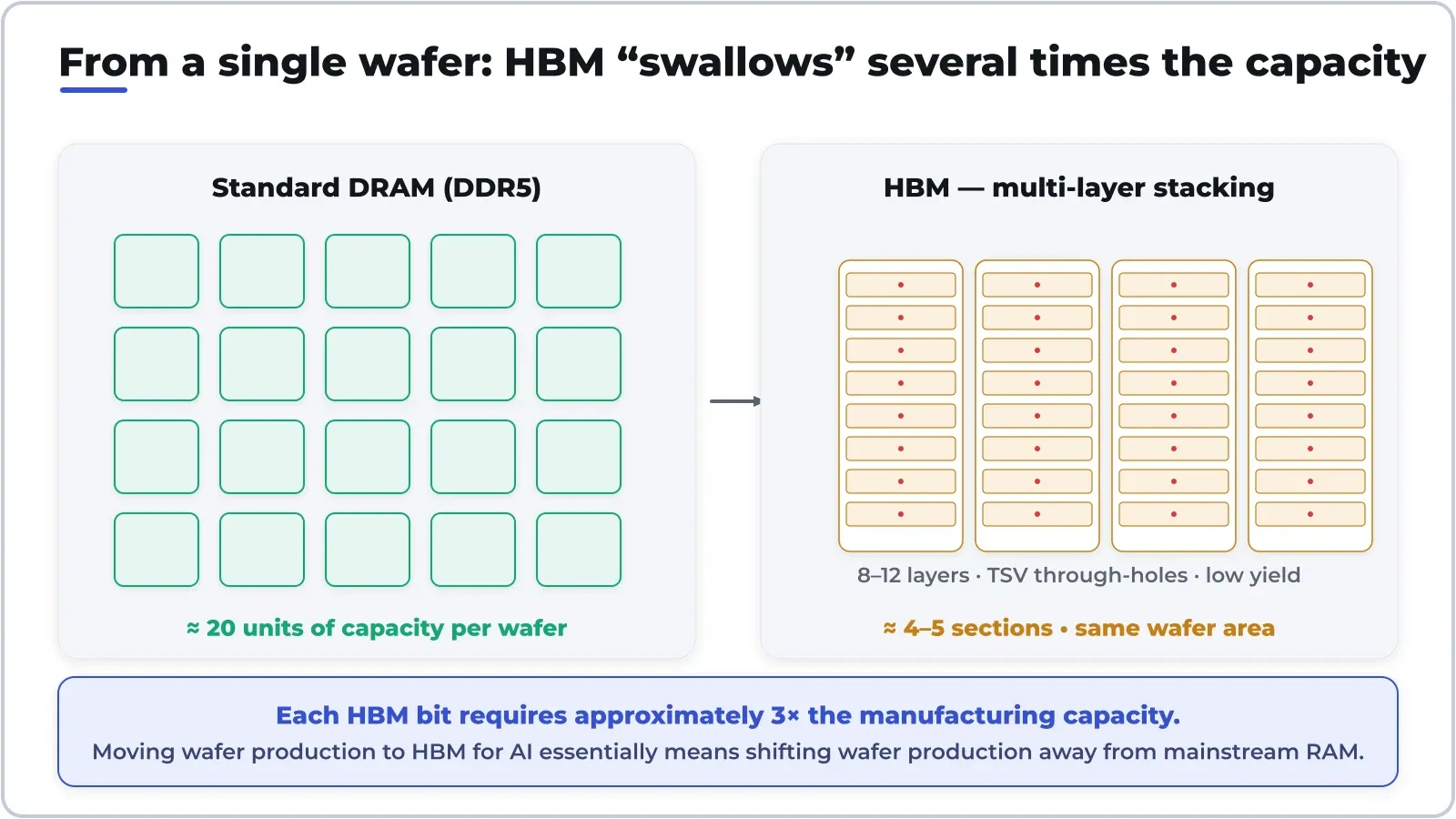
- HBM consumes significantly more resources. HBM consists of multiple DRAM dies stacked together and connected via through-silicon vias (TSVs), resulting in lower yield rates. Given the same wafer, producing HBM yields far fewer “units of capacity” than standard DDR—each bit of HBM consumes about three times as many manufacturing resources.
- Delayed investment. Following the supply glut and heavy losses of 2022–2023, all three companies slashed capital expenditures. By the time AI took off, new capacity hadn’t been built in time.
- Concentrated supply. Just three companies control nearly the entire global DRAM market—leaving no buffer to absorb demand shocks.
- Physical and time constraints. DRAM is becoming increasingly difficult to scale down (capacitors are nearing their limits), requiring the use of EUV for new nodes; building a new factory takes 2–3 years, and ASML’s equipment is on a waiting list.
What are the parties doing?
- Manufacturers are opening new plants (SK hynix’s Yongin complex/M15X, Samsung P4, and Micron’s facilities in Idaho and New York) and accelerating the development of HBM3E and then HBM4, while transitioning to the EUV node. However, it will take 2–3 years for this capacity to actually reach the market.
- Foundries (TSMC) are expanding advanced CoWoS packaging—the link that integrates HBM with GPUs. HBM4 also shifts the logic die to the foundry, turning the foundry into a link in the memory supply chain.
- Hyperscalers and AI companies are signing long-term contracts and pre-purchasing inventory; simultaneously, they are optimizing to require less memory: KV-cache compression, quantization, sparse models (MoE), and memory consolidation/hierarchical organization via CXL to use each bit more efficiently.
- Governments are providing subsidies (such as the CHIPS Act and similar programs) to bring manufacturing back to the U.S.—but subsidies cannot shorten the physical construction timeline.
- Long-term: 3D DRAM and new memory types—promising, but not in time to save this cycle.
The U.S.-China Life-and-Death Standoff: Who Holds the Indispensable Card?
Behind the chip shortage lies a much bigger game: who holds the link that the other side cannot replace within a reasonable timeframe. This isn’t a race to see who can produce the most chips—it’s a race to see who can withstand a supply disruption.
The U.S. and its allies control the upper reaches
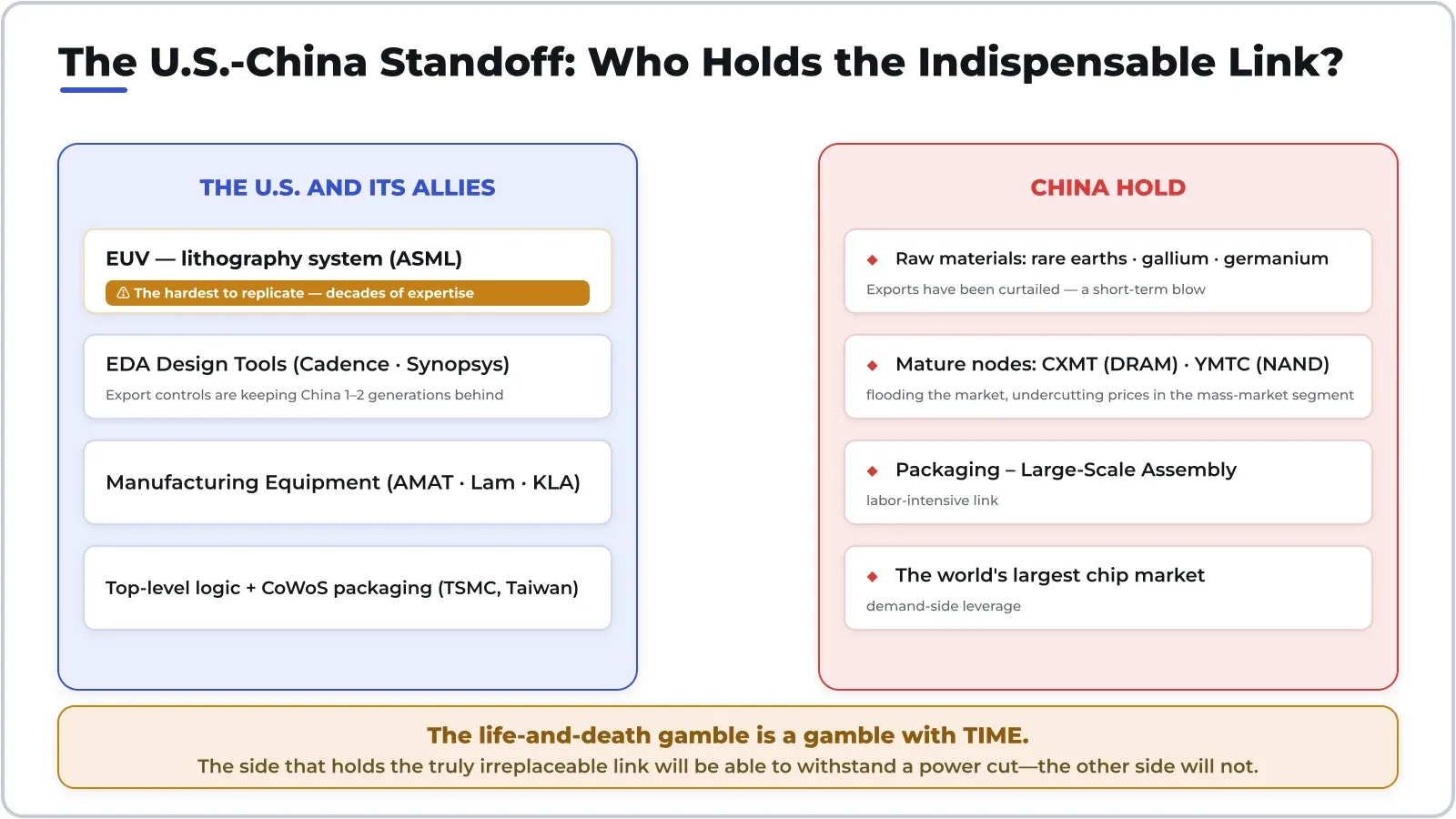
ASML’s strongest asset is its EUV technology—the only company in the world capable of producing it, drawing on decades of expertise in optics, materials, and its proprietary supply chain. Alongside this are EDA design tools (Cadence, Synopsys), manufacturing equipment (Applied Materials, Lam, KLA), and TSMC’s top-tier logic and CoWoS packaging capabilities. The U.S. strategy is to use export controls to keep China one to two generations behind at the advanced node—where HBM and AI GPUs are manufactured.
China controls the downstream sector and raw materials
The countermeasure lies not in machinery but in inputs and scale: restricting exports of rare earths, gallium, and germanium—materials for which the U.S. cannot establish alternative supply chains within a few quarters. At the same time, China is pouring money into mature sectors: CXMT is producing DRAM, YMTC is producing NAND, with output rising rapidly and driving down prices in the mass-market segment. Add to that its massive packaging and assembly capabilities and its position as the world’s largest consumer market for chips.
Where Does True Asymmetry Lie?
The two sides do not hold the same cards. The link that the U.S. holds is deep technological expertise—it takes many years to develop and is very difficult to replicate. The Chinese link is broad in terms of scale and raw materials—it causes immediate pain, but in theory, it can be replaced with new mines and new factories, though it will cost money and time.
So this is a race against time. The U.S. is betting that the equipment embargo will prevent China from ever developing EUV on its own, and that the technological gap will be wide enough to maintain its advantage. China is betting that it will achieve self-sufficiency—even if through indirect means (multi-layer embedded lithography, chiplets, 3D DRAM)—before the pressure suffocates its industry; at the same time, it is using raw materials and low prices to wear down the other side’s resolve.
What matters to the rest of the world: every scenario drives up memory prices. The tighter the lockdown, the more investment is split between two parallel ecosystems—with a surplus here and a shortage there—which is far less efficient than a single global supply chain. And if China overinvests in mature nodes, the mainstream segment could swing into a state of oversupply while HBM remains in short supply.
How long does it take to work?
- 2026 — Still tense. There’s no “switch” for a quick resolution; prices remain high and may hit a peak this year.
- 2026–2027 — Fragile relief. New capacity and HBM4 come online, but AI demand also rises; the balance hangs by a thread.
- 2027–2028+ — Conditions will ease if the pace of AI investment slows. The downside risk: if capacity comes online just as AI demand cools, the market could swing into oversupply, much like in 2023.
Hard Bottlenecks — and Why We Need to Look Elsewhere
The bottom line: Some bottlenecks cannot be resolved in the short term, no matter how much money is spent—fab construction time, the physics of DRAM, CoWoS/TSV packaging capacity, the number of suppliers, and EUV equipment delivery times. When a constraint is hard, the only optimal approach is to reduce the load on it, not to try to force it open.
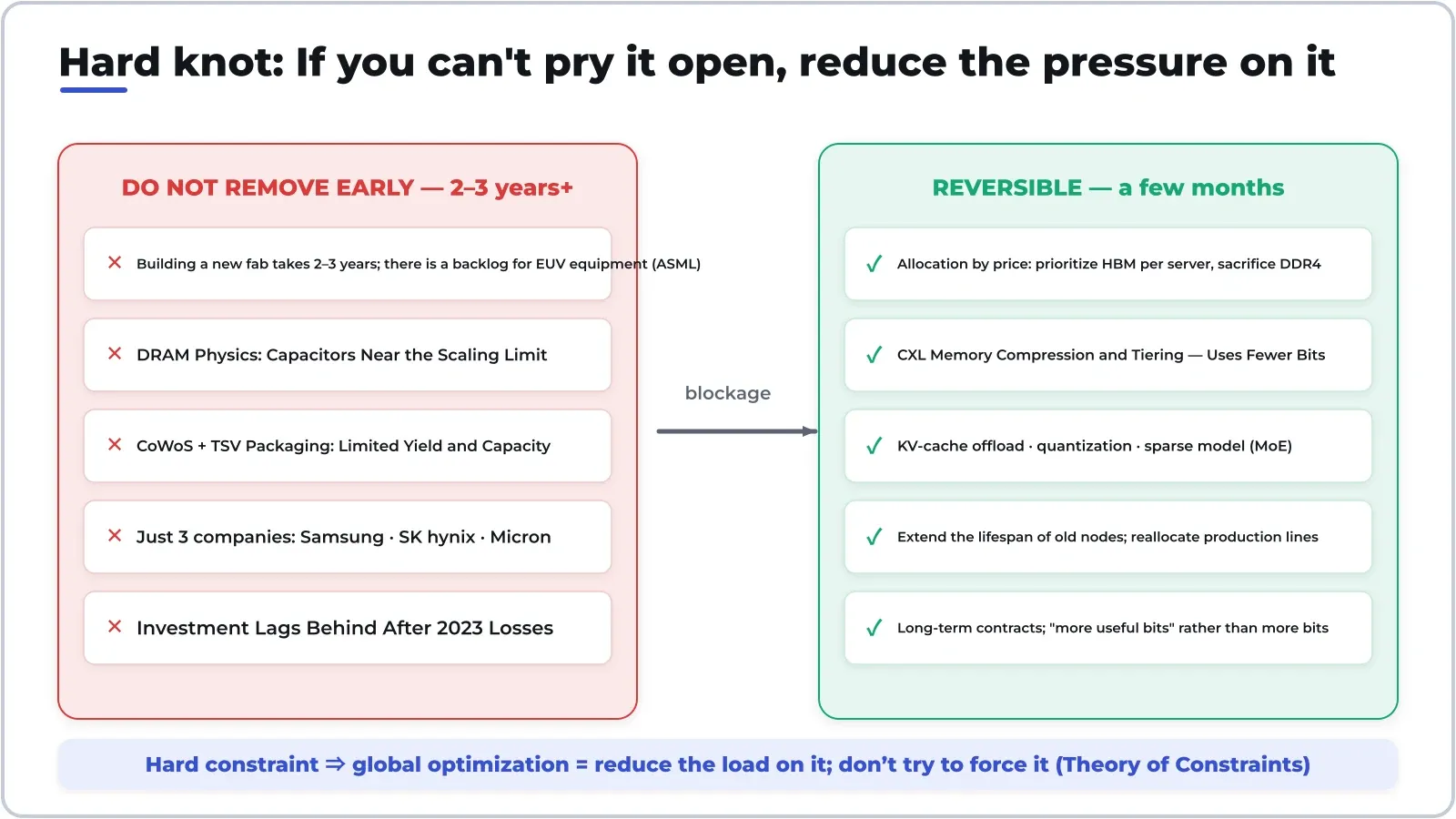
That is why the industry is shifting toward soft solutions: allocating resources based on price (prioritizing HBM and servers, while sacrificing DDR4 and consumer products), using software to reduce the number of bits required (compression, CXL tiering, KV-cache offload, quantization), extending the lifecycle of older nodes, and shifting the philosophy from “more bits” to “more useful bits.” This is the Theory of Constraints applied to hardware: the entire system is only as fast as its bottleneck, so global optimization means avoiding and reducing pressure on the bottleneck, rather than optimizing areas that already have excess capacity.
Prediction
- Memory prices are expected to remain high throughout 2026, with the peak likely occurring in the middle of the year; PC and smartphone users will continue to face high prices, and DDR4 will virtually disappear.
- Foundries become a key link in the memory chain. With HBM4 using logic chips as the base, TSMC and Samsung foundries are stepping fully into the DRAM value chain—blurring the line between “memory manufacturers” and “foundries.”
- Memory efficiency becomes a competitive advantage. Models and systems that perform well with less memory (small KV-cache, compressed context, MoE) will gain a real cost advantage; CXL pooling becomes the default in data centers by 2026–2027.
- Cycle risks remain. The memory industry has always swung to extremes in both directions; those who remember the lessons of 2023 will be wary of a shift to oversupply as new capacity floods the market just as AI demand stalls.
In short: this crisis is the shadow of a boom. As long as every memory chip can be converted into economic value through AI, demand will continue to put pressure on a supply constrained by physical and temporal limitations—and whichever side knows how to relieve the pressure on the bottleneck rather than just scrambling to buy will come out ahead.
Thảo luận