

The article on Apple Silicon boils down to one point: value is shifting from individual components to the way they’re assembled. But assembly is just one of two major strategies tech companies are pursuing. The other strategy is the exact opposite: instead of controlling the entire stack, dominate just one layer of that stack—and sell it to everyone. These are two opposing bets on the same question: where will value converge?
Two directions, two ways to bet
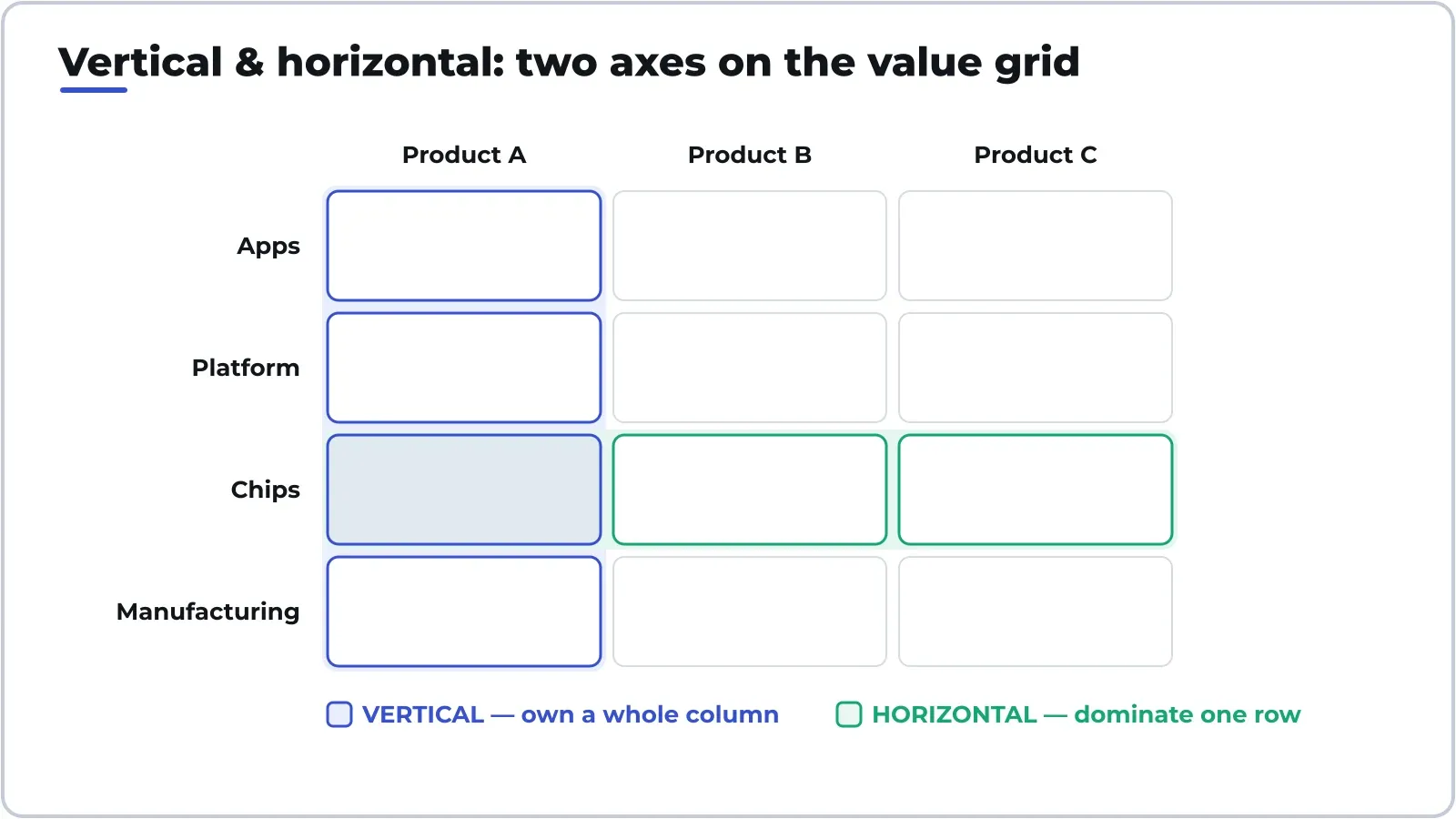
Vertical integration means controlling multiple layers of a technology stack, from top to bottom. Apple makes chips, operating systems, and devices; Tesla makes batteries, software, and even a charging network; Amazon builds cloud infrastructure and then uses it to run its own stores. The key point here is that value lies at the intersections between these layers, and whoever controls those intersections can optimize aspects that companies operating at only a single layer cannot reach.
Horizontal integration means dominating a single tier, spanning the entire market, and selling to everyone—including each other’s vertical competitors. TSMC doesn’t make any end products; it just manufactures chips for everyone. Stripe only handles payments. ARM only sells core designs. The bet here is the opposite: value accumulates at a layer with massive economies of scale, and the winner of that layer collects a cut from everyone building on top of it.
| Vertical Integration | Horizontal Integration | |
|---|---|---|
| Strategy | Dominating Multiple Layers of a Stack | Dominating a single layer across the market |
| Examples | Apple, Tesla, Amazon | TSMC, Stripe, ARM, Cloudflare |
| Winning when | Value lies at the intersection of layers | A tier with overwhelming economies of scale |
| Approved | Globally optimized, deeply differentiated | Scale, profit margins, neutral |
| Disadvantages | Huge capital requirements, loss of flexibility, locked-in | Dependence on the overarching ecosystem |
Why does the same market have both?
What makes this topic interesting is that these two approaches are not mutually exclusive—they often coexist within the same industry and even depend on one another. Apple is vertically integrated, but its chips are manufactured by TSMC—a horizontal giant. No matter how tightly vertically integrated a software company is, it still runs on someone else’s horizontal cloud infrastructure. In other words, every vertical stack rests on several horizontal layers, and every horizontal layer serves multiple vertical stacks. The strategic question isn’t “vertical or horizontal” in the abstract, but rather: at this specific layer, in which direction is value converging?
The cycle of coming together and then separating
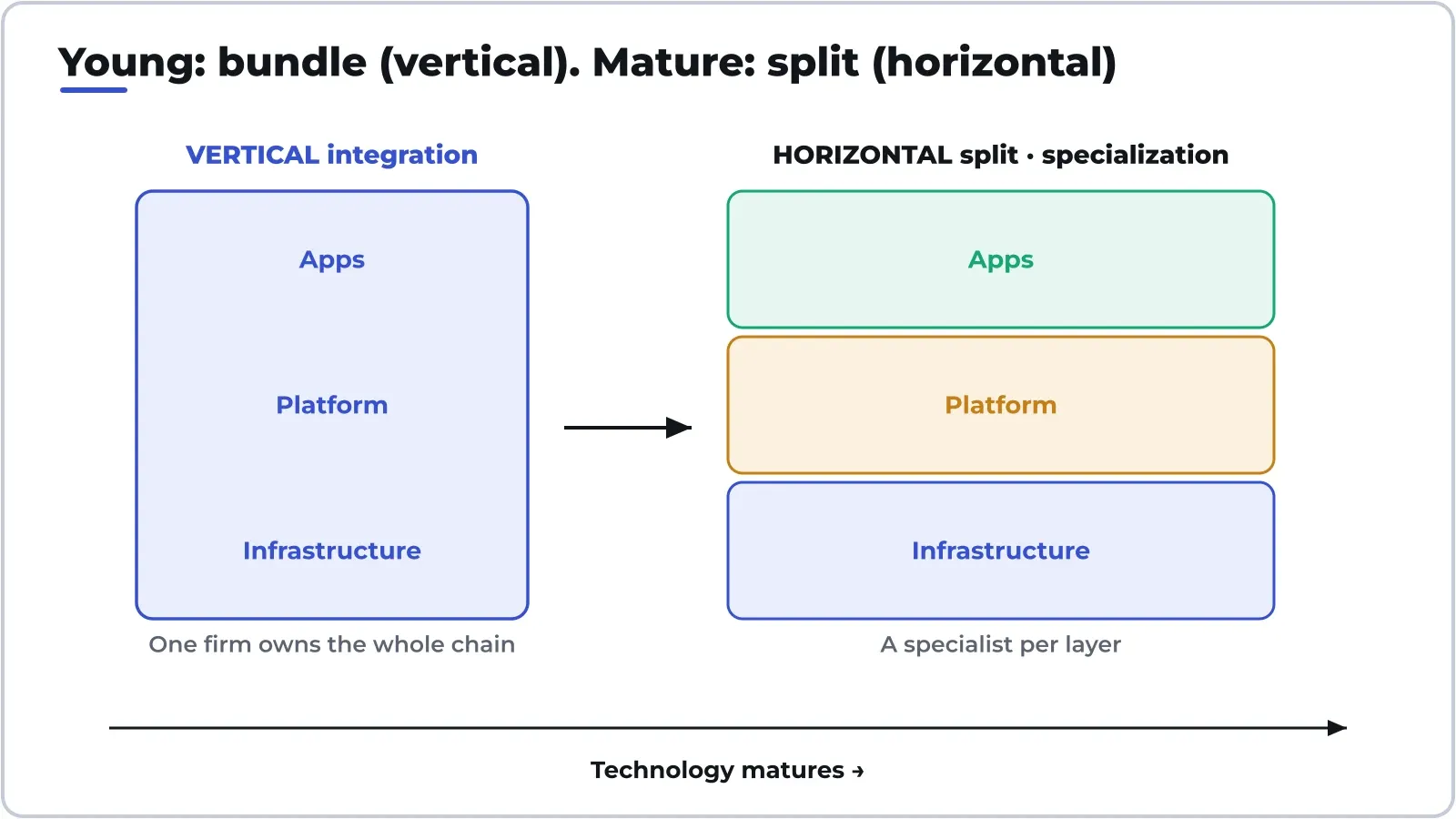
There is a recurring pattern in the history of technology, and understanding it helps predict the next move. When a technology is still in its infancy and its layers are not yet standardized, vertical integration prevails: companies must build every layer themselves because no existing layer is good enough to buy, and the interfaces still have significant friction that requires overarching control. Early computers and early electric cars both began with companies that did everything themselves.
Then, as the technology matured, the layers became standardized and separated, and horizontal integration prevailed: each layer became its own market with a specialized winner—cheaper and better than anyone could achieve on their own. Personal computers split into chips (Intel), operating systems (Microsoft), and hardware (multiple manufacturers)—each layer dominated by a horizontal player. But then the cycle reverses: when a layer becomes so commoditized that it no longer offers differentiation, a new vertical player emerges, combining the layers in a new way to gain an advantage—just as Apple did at the right moment, after PCs had been fragmented for too long. Consolidate, fragment, then consolidate again; whoever correctly identifies which stage of the cycle they’re in will make the right bet.
Areas Still to Be Explored
In addition to these two classic strategies, there are a few less-discussed approaches that are reshaping the landscape:
- "Thin bottleneck" — a narrow interface standard that allows both vertical and horizontal elements to coexist. The Internet’s IP protocol, USB ports, or container standards are examples of "bottlenecks": a thin, standardized layer through which everything above and below passes. Those who control the bottleneck don’t need to integrate vertically or horizontally—they define the rules of the game for both. This is the most powerful position, yet one that few aim for because it lacks glamour.
- Platforms act as aggregators of demand. Some companies don’t control any layer in the traditional sense of production, but they control the relationship with end users—and from there, they influence all the layers behind it. Whoever holds the demand holds the power, even if they don’t own the supply. Linked to the discussion on network effects, this is a third path alongside vertical and horizontal approaches.
- An open ecosystem as a strategy. Instead of being closed (vertical) or monopolizing a single layer (horizontal), some choose to open standards for everyone to build upon—betting that a large, open ecosystem will outperform a perfectly closed one. Open command architecture and the open-source model are testing this very strategy.
- Vertical integration in a new field: AI. Leading AI labs are quietly following Apple’s path: building their own models, designing their own chips for their workloads, and creating their own end products. If the AI stack is still nascent and the layers aren’t yet standardized, the cycle theory suggests that vertical integration will prevail at this stage—and that’s exactly what’s happening.
Predicting the Next Steps
If the "grouping and separation based on technology maturity" framework is correct, it yields some fairly specific predictions:
- AI will see strong vertical integration over the next few years, and then begin to fragment. Because the AI ecosystem is still in its infancy, major research labs will continue to handle everything from models and chips to products. But as soon as the layers mature—when there are “TSMCs of AI computing” and stable model interface standards—pressure to decouple will emerge, and a layer of specialized horizontal companies will emerge at each level.
- The chip manufacturing tier will become increasingly horizontal and concentrated. The cost of building a state-of-the-art foundry is so high that only a handful of players worldwide can afford it—the economies of scale from horizontal integration here are nearly absolute, and they will become even more concentrated, turning this tier into the industry’s geopolitical bottleneck.
- The real battle will be over who controls the AI bottleneck. It won’t be about who builds the best models, but who defines the narrow interface layer through which all AI applications must pass—how tools are invoked, how context is embedded, and how authentication is handled. Whoever holds that chokepoint will be in the position of the rule-maker, just as happened with operating systems and web browsers.
- Vertical integration will make a comeback in consumer hardware. The success of Apple Silicon is a sign, not an exception. Large companies with sufficient scale will increasingly manufacture their own chips for their products, accepting the costs of vertical integration in exchange for optimizations that outsourcing cannot provide—and the line between “software companies” and “hardware companies” will blur.
The common thread among all predictions: no single direction wins forever. Vertical and horizontal trends take turns dominating as each phase matures, and a skilled player isn’t someone who sticks to a single strategy, but rather someone who correctly identifies which part of the cycle they’re in—and then bets against the crowd just early enough. As the article on vendor lock-in noted, every control mechanism has two sides; the art lies in choosing the right thing to control, at the right time.
Thảo luận